


G'day from W.A.
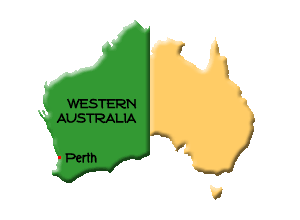
 "Do Not Enter"
 |
The majority of Australian spiders are new to science. Most southern hemisphere spiders are unknown! Australia leads the world in the number of venomous spiders as well as the toxicity. However, of almost 10 000 species of spiders in 70 families throughout the country, most are harmless to humans and interesting to study. |
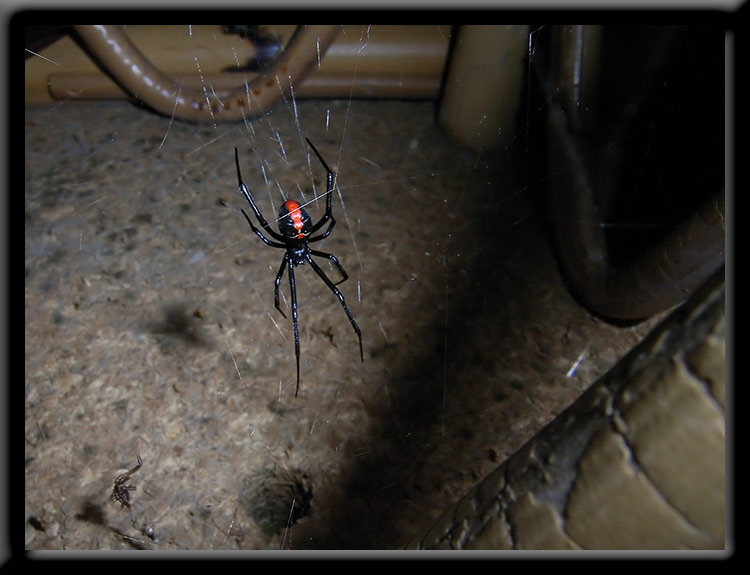 Latrodectus hasseltii
Redback |
Most spiders in Australia are venomous but only two have caused deaths, the Funnel Web and Redback. The Redback is the most well known Australian spider and found in all areas except the highest mountains and deep in the ocean. She can store sperm up to two years then lay 10 egg sacs, each containing about 250 eggs, and can repeat this a week later. |
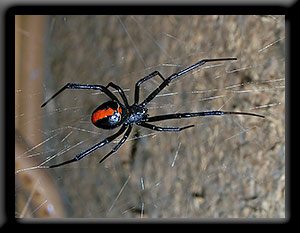 "Do Not Touch"
 |
Closely related to the Black Widow and identical except for the red dorsal stripe. The Redback "venom is highly neurotoxic, which is to say that it attacks the central nervous system causing intense pain, profuse sweating, difficulty in breathing, loss of consciousness, violent convulsions and, finally...Death." Prior to the introduction of specific antivenom in 1956, Redbacks had been responsible for thirteen deaths in Australia. None since! More redbacks |
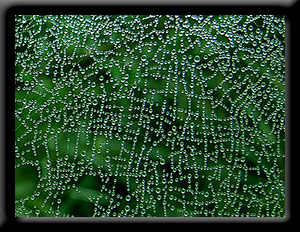 Web Drops
 |
Most spiders are predators with eight legs, eight eyes, fangs and venom but the the most prominent feature is the ability to produce silk. Silk is used as a safety-line, to catch prey, wrap up prey and to make egg sacs. It is also used for transport, shelter and courtship. |
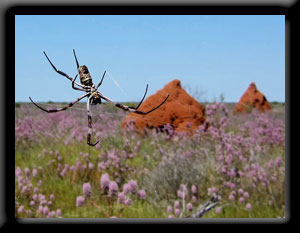
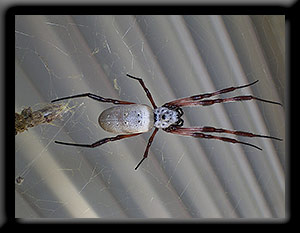 Nephila edulis
Golden Orb |
The Golden Orb spider gets her name from the beautiful golden, orb-shaped web that she makes. This web is the largest and strongest in the world. The tiny males live on the edge of her web feeding on small insects. They are so small that they can sneak in for a quickie without the female noticing. But if they are caught they may get eaten. |
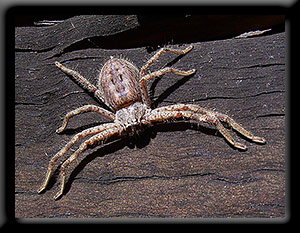 Isopedella flavida
Huntsman |
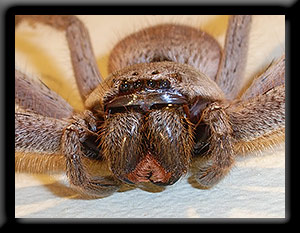
Huntsman spiders are those big, hairy, scary, long-legged spiders we often find behind curtains, in the shower cubicle and under the car's sun visor. These timid creatures are harmless and will run from humans at lightning fast speeds. The design of the legs allows the Huntsman to run sideways as well as forward. |
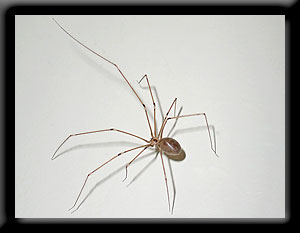 Pholcus phalangioides
Daddy Long Legs |
Daddy Long-legs hunt, kill and eat Redback Spiders, House Spiders, Wolf Spiders and more. An ideal pet to keep in the house. When hunting other spiders it will tap the victims web to attract it, quickly envelope it with silk and then inflict the fatal bite. When threatened by a touch to the web the Daddy Long-legs become invisible by vibrating rapidly and becoming blurred. Their main predator is the vacuum cleaner. |
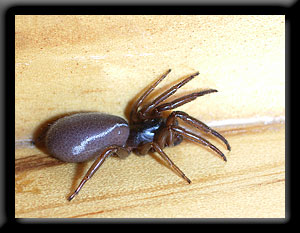 Badumna insignis
Tubeweb |
Segestriidae - Tube-dwelling spiders have only six eyes. They build a tubular web with radiating silk triplines for detecting prey. (Monitored by the six forward legs.) |
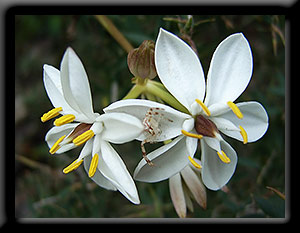 Thomisus spectabilis
Crab Spider |
Flower Spiders (or Crab Spiders) are colourful and camouflage well in flower petals. This serves a dual purpose of hiding from potential predators and concealing from possible prey. They feed on nectar feeding insects including bees. |
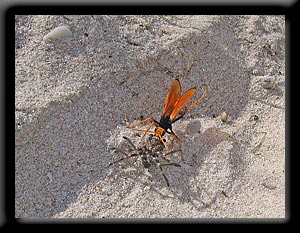 The Battle
 |
This spider has been immobilized by the sting of a wasp and will become living food for the larvae. |
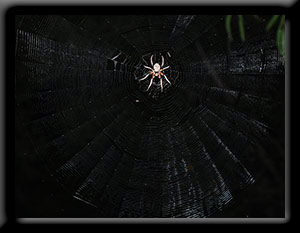 76 Spirals
 |
Garden orb weaving spiders are common in yards during summer. They build their webs in the evening and before daylight will usually eat the web, then hide all day. They are non-aggressive and low risk to humans but walking into a web at night can cause panic, especially if the spider is on your face. |
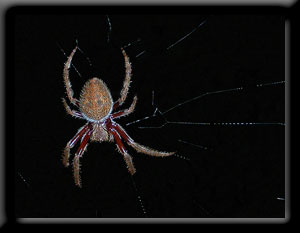 Eriophora biapicata
Garden Spider |
This Garden spider ejected about 10 super-fine silken threads, over a metre long and joined at the end. This blanket of silk floated to a nearby plant and attached to a leaf. The spider then pulled in all the slack silk lines until it formed one strong anchor thread for the foundation of the web. The spider didn't move! |
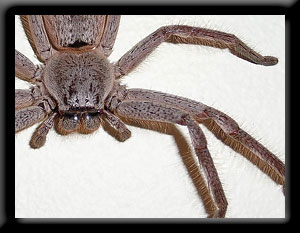 Harry
Harry |
All the indoor pics were taken inside my house. I removed the Redback, the Daddy Long Leg ate the Black House spider and Harry the Huntsman is still here. |
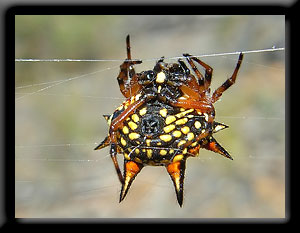 Austracantha minax
Jewel |
Jewel Spiders (Christmas or Spiny spider) are orb weavers. These tiny spiders are usually found on a web strung between two bushes. They look like a creature you don't wanna touch. |
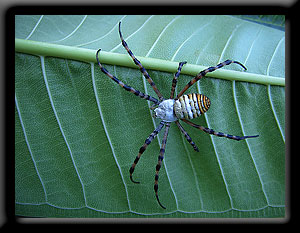 Argiope trifasciata
Bandy |
Banded Garden Spider or Banded Argiope Generally seen arse-up in the centre of an orb web, with legs together in pairs. Trifasciatas are found throughout Australia around autumn. Often mistaken for the St Andrews Cross spider which is only found in the east. These awesome creatures are totally harmless. |
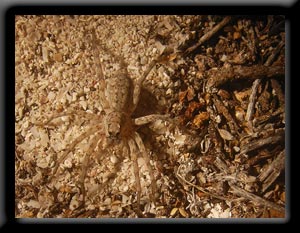 Wolf Spider
 |
Tiny immature wolf spiders hiding in the dunes at Cape Range NP, Exmouth. Wait until dark, grab a torch, enter the sand dunes and hold the torch about eye-level. The bright pinpricks of light in the sand are reflections from the spiders eyes. I saw up to 10 from one location. When alarmed the spider will quickly disappear into the sand. |
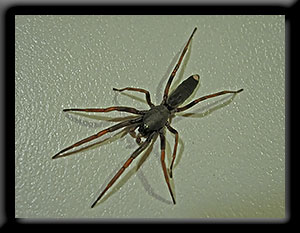 Lampona cylindrata
White-tailed Spider |
Here is a Flickr group
on Australian spiders with a search function. You can post spider pictures and get feedback from others. Check out Jean's collection of spiders from W.A. |
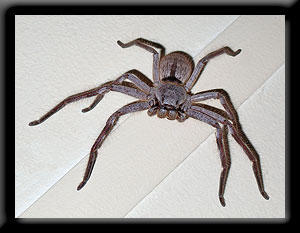 Huntsman
 |
I think most aussies have a scary Huntsman story. |
 |
 |
|
Most Popular Comment Cherry - Huntsman Spiders are my favourite. I used to be terrified of spiders as a kid, but then my dad found a young one and said it looked hungry, so I caught it in my brother's bug catcher and gave it a few flies. It tried to gobble up three flies all at once, and after that I was no longer afraid of spiders. I decided to keep "Inci" as a pet, and after a few months of feeding him daily, he shed his skin. It was an awesome sight watching it happen. Anyway, he moulted every few months, and grew to as big as my dad's hand. Inci grew so tame that he would know when I was picking his cage up to feed him, (he'd get all excited), or when I was just picking it up to handle him. I let him run up and down my arm under my jumper sleeve and out at my neck like a pet mouse would. To make a long story short, I found so many interesting things about huntsman spiders (I decided to breed them and have studied them for about 7 years). Their venom is pink; the males are hairier and have more red-fuzz around their fangs than females; if they lose legs, they grow back at the next moult; and their blood is a clear turquoise colour. The females lay an egg-sack that's about the size of a ten cent piece, and have about 100+ spiderlings in each one. When the babies hatch in the egg-sack, the mother will chew a hole in it to let them out, and she counts them as they come out by having a foot over the hole. I've heard a lot of people think that they can jump, but they don't. If they're afraid they'll run, then suddenly drop off the wall they're on. Generally if you don't bother them, they won't bother you. ;-) |
|

All pics taken by  Ray
and copyrighted 2003 - 2022.
Ray
and copyrighted 2003 - 2022.
Comments - newest first
Daniel
Reply
Gday there. Im looking for spider collectors from Perth. I started a spider terrarium to teach my 2 young toddlers the difference between spiders, which are dangerous, not to touch how they live etc. it has been a great experience for my family and i. I collect different spider around the house. We have had huntsmans, wolfspiders, white tips, golden orb weavers, black house spiders, little jumping spiders and red backs.
My reason for this comment is the enclosure with red backs has had 2 eggs sacks hatch and so many babies, so i was wondering if there was a place in perth i could donate them for study, anti venom etc.
Would be nice to know 👍
Cath
Reply
Friends found a large white spider with vivid red markings on the body and vivid red and blue markings on the legs. Any ideas what kind of spider it was?
Emma
Reply
My Scary Huntsman Story would be when I was out the back having a BBQ and I got up from my chair to go over to my Mum. I turned back to my chair for whatever reason and watched as a big Huntsman fell down from the patio ceiling and landed on the chair.
Troy
Reply
Hello
Have funnel web spiders been found in WA bushlands? If not what spiders in WA dig holes and live in the ground with funnel type Web? Have pic of hole/web but not of the spider.
Pest Control Service
Reply
You will see spiders however you'll principally got to seek for the toxic ones. the foremost visible tend to be the smallest amount toxic. simply keep the house clean, sweep/vacuum corners and beneath piece of furniture, you would possibly have some surprises, you would possibly not. Use your eyes to examine things that haven't been affected during a whereas, this includes garments that are sitting on the ground for three days. simply bear in mind. If you're ever bitten by one thing keep calm and take a look at and observe the creature. Basic tending coaching could be a should in Australia. www.pestcontrolservice.com
Spider
Reply
Spiders are crap
Elsie
Reply
Creepy!!!!!! They make my freak out!
Maybelle
Reply
Hi, Can u tell me what spider is brown and hairy with a black flat spot on its back and very distinctive brown & cream striped legs?
David
Reply
About twenty five years ago I saw three spiders in The backyard of a display home in what was then the new coastal suburb of Clarkson north of Perth.The spiders were orb weavers their legs were fluroesent blue similar to blue swimmer crab legs and they were the largest spiders I have ever seen.Easily twice the size of the largest Golden Orb Weavers. I have not seen spiders that size or of that species since.Do you know of them ? What were they?
Jay
Reply
I took a photo of a white spider in my garden after I cut the lawn. I've no idea what it is! I have a photo and a video of it. I would love to know what it is.
Jean
Reply
Am trying again mainly because tragedy has struck! I originally tried to find out if others had seen similar behaviour in a spider. We live in the Perth Hills and I have had a beautiful black house spider living in the corner of the window above my shower for well over a year. A few weeks ago we had a sudden cold snap after some really extreme heat. When I was having a shower, I noticed her climbing up her web until she could reach the window pane. She then started to scratch rhythmically with her front legs as far up and out as she could reach causing droplets to form and run down towards her mouth. She then seemed to be drinking the water. She eventually cleared quite a large area of the glass. This happened again the next day. It was fascinating to watch. And now to the tragedy and another puzzle. Yesterday, I noticed that some large grey flies had managed to squeeze down through the extractor fan and were dropping down into the bathroom. Obviously something had died in the ceiling and what looked like carnivorous flies had hatched. I couldn't spray because of the spider so went to fetch a fly swatter. Meanwhile a large fly landed in the web and she made a dash at it, grabbed it and dragged it back towards her corner. I swatted a few of the flies and then noticed, to my horror, that the spider seemed to be in trouble. Within less than a minute she let go her web, fell twitching onto the window ledge and died!!! What on earth happened here??????
Bryan
Reply
The fly may have ingested poison earlier that didn't bother it but did bother the spider. :( Sorry for your loss.
Mack
Reply
I found a golden orb spider in my yard your website was very helpful
Jean
Reply
Hi there! What happened to my query about my Black House Spider clearing condensation from my bathroom window with her front legs and appearing to drink the droplets that formed?
Jean
Reply
Have a black house spider who has lived in the corner of the window in my bathroom for a year or two. She is beautiful. We have had a really cold spell in the Perth Hills both yesterday and today and the window fogged up when I was showering. To my surprise she came out of her hole, climbed up her web until she could reach the window and then proceeded to scratch her front legs backwards and forwards on the glass causing small droplets to form which she then appeared to be drinking! She "cleared" quite a large area of mist off the glass in this way! Is this an unusual sighting or do they do this regularly to get a drink?
Fren
Reply
Recently my cat was bitten by (presumably) a spider. The skin around the site inflamed and became necrotic through tissue and into muscle around her neck. The only spider I have read that has this type of venom seems to be a brown recluse spider but I can't confirm if they're in Perth. My main concern is not knowing what to look for in future so I can relocate it.
Do you know of any spiders in Perth that could cause such a reaction in animals?
Carol
Reply
White tail and black/brown house spiders most common and plentiful. That's what I'd put my money on (if it was a spidee).
suze
Reply
VENOM TOXICITY - non aggressive - rarely bites BUT has potentially dangerous venom. Area of distribution - Brown Recluse Spiders are NOT found in Australia although some have been found in Adelaide. It is sometimes called a Violin Spider or Fiddleback Spider because of a violin-shaped marking found on its body
Kate Jefferies
Reply
Hi, I tried to paste a photo for you but it won't work. We have a beautiful spider in our boot room. A bit like a huntsman but not flat. About 8cm legspan, or more and really big body, at least 2cm X 1.5cm. I wondered if it was a pregnant female but don't know what sort of spider. We live in Tenterden, an hour north of Albany on the south coast. Any idea what she might be? I thought it was a mouse at first, she's so big, and that sort of colour. Thank you! Kate
Kristin
Reply
Hi we are living in Perth and have found a couple of holes in our lawn and in the garden, are there any spiders that live under the ground in Western Australia?
anonymous
Reply
I don't like spiders and I have to do the tarantula for a high school assignment!!!
Kathy
Reply
Hi, I was recently on camping/walkign trip in the Pilbara (Karijini NP). Saw the bright reflective eyes of spiders at night. One quite small that we see here (South Australia) and another one that was larger (with legs, about the size of a 20-50c coin) with brighter bigger eyes, ground dwelling, seemed to have black/white legs and quickly disappear down a hole when you got too close. Any tips on what the bigger one could have been?
Mark
Reply
All your photos but the first name the spider. What is this one since I recently encountered it at Coral Bay.
Ray
Reply
It's a Huntsman
Caitlin
Reply
I was in my garden and I saw a hole. It was about the width of a ten cents piece. I got a long stick and some Warter and tried to wash whatever was in there out. It turned out to be a huntsmen looking spider with brown and black and red lines decorating it. It was about the size of my palm. I freaked out and jumped back and said:"oh!!!!!!" I ended up killing it and bereing it in its hole:0
Mikko
Reply
Anything of that size living in a HOLE in the ground is most probably a trapdoor spider. All trapdoors, bird-eating spiders, mouse-spiders and funnel-webs are MYGALOMORPH spiders, the most primitive of all spiders. They are usually large in size, dark-coloured and exclusively ground-dwellers. The males tend to be vagrants, i.e walk around and are smaller and slimmer than the female. All mygalomorph spiders can at least induce a very painful bite, and all should be handled with care, that is, don't touch!
Caitlin
Reply
Can you send me your email so I can send a pic of my spider?🕷
Rosemary Hamp
Reply
I found a large black spider with slightly hairy legs in our bath this evening and would like to know the name of it as I can't find it on any of your charts. We captured it in a plastic beaker - it crawled into the beaker on it's own - and then let it out in the neighbour's garden. How can I send you the two photos I took of it please?
Mich
Reply
Can you tell me are Huntsman or Wolf spiders ever all over very white and VERY hairy? This palm sized spider was on play equipment a few weeks after a tree crashed down in my front yard. Never seen one before. Assume it came from the tree.
Mikko
Reply
Yes they can. Huntsmen vary in appearance, size, shape etc. Most likely a huntsman.
sd mandurah
Reply
Love the Vincent Price (Alice Cooper-Black Widow) quote.
And great info.Keep up the good work.
Carla Henco
Reply
little green spider with a white stripe across the back
do you have a name for it
marie tully
Reply
no idea but I had one running over my hand this morning. I would love to know what it is.
Stewart
Reply
Hi, what about our (WA) white tail spider, not like the white tailed one that most pictures display. This one is similar to the red back except smaller and with a white arrow running from partway down its back to its tail?
Is this the opposite sex red back?
Stewart
Chloe
Reply
Hi Stewart,
As a fellow Western Australian and a fanatic about spiders, I can inform you that the spider you describe is indeed not the opposite sex to the female Red Back spider. Male Red Backs are about 3-4 times smaller than the female and not as prominent as the female. Males have a more grey complexion and are a lot thinner than the females also. The spider with the white stripe you described sounds similar to a Wolf Spider. The colours range from a buffy tan to blackish grey and can be mistaken as black from a distance. These also have a greyish-brown stripe down it's abdomen (back) which (also at a distance) can give it the illusion of being a white tail spider.
I hope I helped.
Brooke
Reply
Hi chloe. Im trying to find out anout this spider also- its not a wolf spider - its body shape is almost exactly the same as a redback. I put it in with a red back twice its size. It fiercly attacked the redback and won. It lives rather close and harmoniously to other spidees of the same type ( i have 4 in a 1.5 ltre container) eggs are fluffy unlike the solid redback egg- like cotton wool. I have some photos i could send somewhere- is there some place i could get more info?
Thanks so much!
suz
Reply
the west australian museum may be able to assist they have a web page for identifying spiders or you could send your photo to the museum and they send it to the experts. its hard without a photo but you could send your description there... they identify a lot of spiders for me and people all over Australia.
Vanessa
Reply
Its spring and have found up to the three orb weavers in our courtyard. One on one of our clotheslines which we dont use much, another on the back of a chair and the other has built a web between the narrow gap between the wall and fence (blocking our path down the side of the house!). I don't want to kill them because it would creep/gross me out too much and I know they're harmless and good for the garden. But I want them gone at the same time as I'd like to go outside at night and I'm scared to (I brushed against the web on the clothesline before and looked up to see the spider to my horror!) What should I do?? Also, are they dangerous to dogs?
Jimmy no legs
Reply
Go on the Department of agriculture website and email them a picture of any insect or send it to them via snail mail (dead) sticky taped and they will identify the insect for you free of charge.
Thanks
Cassandra
Reply
I found a large spider in my backyard and can't find it anywhere online, it's dark red, has a large white stripe from its head to its but and a hairy head. I live south of Perth.
Xavier
Reply
What a great site and loved some of the comments and stories too! Just moved to WA from the UK and our house has just been fumigated due to infestation of Ants (they are evil here!!) We also found a dead red back and an old huntsman egg sack according to the gardener we hired who used to have a huntsman in his house that he could hand feed. My partner is petrified of spiders and we also recently got rid of an Orb spider, but after reading this site I am going to try and hide the spiders from her and relocate them!!
Talesin
Reply
This is such an awesome site. We are moving out to WA in the next year hopefully and I can't wait! We are going to have to sell all our spiders and exotics before we move and I am looking forward to seeing snakes, lizards and spiders out and about where they should be. England is not that exciting in terms of wildlife, I have seen all the snakes and lizards we have here (less than 11 if you count slow worms) and our spiders rarely get bigger than a large button. I was born in Melbourne and clearly remember the fantastic preying mantis that lived outside our back door. So I'm just hoping we get something amazing living in our house :-).
Chilli
Reply
When you see a spider just kill it. worlds a better place
Lorrie
Reply
Spiders are vital in the food chain and they also eat a lot of pests. You do not HAVE to kill anything just because you are frightened of it or dont know what it is. Spiders and same with most creatures, are more scared of you than you are of them. Respect the ecological food chain and it will repay you by being natural pest control system...free!
Mandy
Reply
Hello, I had a spider in my laundry and from all my research on size, body shape, colour etc could only be a female funnel web. It ran away VERY quickly and haven't been able to find since. Living south of perth is there any other type of spider you think this could be?
Alan
Reply
Funnel webs are not found in WA. People mistake wolf spiders or trapdoor spiders for funnel webs.
Adria
Reply
Yes they are found in W.A., had them where i used to live down south.
Gilliam
Reply
No, they are not!
Drhoz
Reply
Could also be a mouse spider, or a brush-footed trapdoor spider. Both large and hairy spiders, but not aggressive. They will rear up in a warning display if you scare them, though.
Kirsty
Reply
We've had a lot of very small spiders in the house that look like they are covered in Tiger stripes. Any idea what they are?
Josh
Reply
Hi I am trying to get in contact with someone who has/does successfully breed Wolf Spiders. I am getting a pair of Hoggicosa Bicolors and I'm very interested in breeding them.
Please can you point me in the right direction or leave me some contact details of someone that can help me?
Thank you, Josh, Perth WA.
Clint
Reply
I live in Perth now after growing up in Sydney for most my life when I saw a spider that looks like a male sydney funnel web . I have it in a jar with all but a bit of its rear is it possible can I take it anywhere to be identified. It was at the edge of the pool
Drhoz
Reply
Mouse spider? They're quite like Funnelwebs, and certainly found in Perth. The males wander in search of a mate at the right time of year. Not aggressive but will rear up to try and scare you if you frighten them.
Karen
Reply
Help...my lovely Golden Orb seems to have left home. Do they come back to their web after laying their eggs in the shrubs? She was there last evening and gone this morning. How long do they live for. We used to live in the Pilbara where they are very common. We had 5 webs one summer but don't recall them leaving then coming back to the same web??? Great site by the way. Nice to see I'm not the only crazy spider lover...
Phoebe
Reply
After the golden orb spiders lay their eggs don't they die? I had a golden orb spider in my backyard I watched it lay eggs on this tape I had, it dropped down of the web and died.
Robin Johnson
Reply
I live in Perth W. Australia south of river. I found a bright orange coloured spider very long legs small body similar in shape to a huntsman, no web on the wall stayed there 2days same place. Any idea what it could be
Lamborghini
Reply
As a pomm newly settled in perth, this helped ease my families fears... We have a huge golden orb on the fence, my initial impulse was kill it and clear it's.'zone' after being educated it's now a member of the family... Called him Dave although it's probably a she........ Still tho it's a highly intelligent creature and really helps with the pests (mozzies and flies), will try and upload a picture after finalizing Dave's rental agreement!!
Lee Delgado
Reply
We live north of Perth and have found a spider that we can't identify. Have done the Google search and can't find it anywhere. Wish I could upload a photo here to show you all as it is quite striking, anyway it has a velvet blue abdomen and red legs and head, similar shape of a red back. Anyone have any idea on what type it might be?
charlotte
Reply
Hello,
Have you looked up Nicodamus peregrinus? It looks similar to what you have described.
Drhoz
Reply
Male Mouse Spider? Not particularly red-back shaped though
Draza
Reply
lol
Paul
Reply
Thanks for the great web site
Friday we were playing golf and a small (12-15 mm) black spider with white markings on the front part of his body ( closest to head) crawled across the green In front of us.
We put one of the clubs down in front of it which didn't make him very happy. He opened his mouth exposing a ruby red mouth and fangs
We moved the club and the spider then went happily on his way
Any idea what kind that might have been? We thought it might have been a male red back but seemed larger than the females
Thanks in advance
L
Reply
Sounds like a male mouse spider
Sam
Reply
Hi there,
I have a story to tell, but it involves trying to identify a spider too. So the first thing is:
This spider is tiny. I mean approx. 2-3mm long from the tip of the thorax to the tip of the spinnerets, which I actually cannot see because they must be so small.
Its leg span from the body is approx 7-10mm from attachment to the thorax to the tip of the leg. The legs are colored a pale yellowish brown with very dark spots at each segment of the leg.
It's mandibles, or whatever they are called, are really thin at the head where they attach, but very bulbous at the ends almost like a snails eyes.
The abdomen is like a pale dirty brown, with a very pronounced central white dorsal stripe, with two identical parallel dorsal stripes either side of the central one, separated by the same dirty brown color of the rest of the abdomen.
Okay so the story is:
3 days ago I was bitten in the midst of the night. I thought it may have just been a bull ant, so at first I did not think much of it. I got out of bed and got my little LED flash light and started scanning my side of the bed for a black ball that would signify a bull ant (did NOT want to wake my partner less she bite me too :@). But after about 20 seconds, the pain did not start getting less sharp as a bull ant bite normally would. This triggered something in the back of my mind to keep looking and find whatever it was, so after about 2 mins of looking, I spotted this little spider crawl out of the blanket (where it would have been over my legs), and start it's little walk over the top of the blanket and onto my partners arm. At this point I flicked it off her towards me (smart moves...) and she woke up. I then placed the torch directly over the spider and it seemed to be subdued by the bright proximity of the LED lights. I asked my partner to turn the lights on and get a container and told her I'd just been bitten by it. She grabbed a container and I managed to coax this thing into and closed the lid.
Thats when I saw the stripe on it's back. I instantly remembered stories of white tailed spiders that cause necrotic arachnidism told by my mother... Oh the fun of being a kid.
So seeing this stripe, I immediately got ready and headed stright to the hospital where they treated me with painkillers (which just so you know, the pain got MUCH worse over the course of 30 mins and started burning almost as though I'd spilled boiling water on the spot.) and antihistamines. The triage nurse told me that white tails are now only treated generally as most spider bites are and no longer have specific anti-venom. Apparently this has been since a study in 2003 found that they are not actually liked with the infection that causes necrosis in the bite.
Now after this trip to the hospital I went home and went to sleep. the next morning I woke up with a splitting headache and the bite area was itching like crazy. It was still red and hurt a little, but was not hurting so much that I noticed it after my morning shower. The headache passed over the course of an hour, so I just scratched it up as sleeping the wrong way.
When the bite first occurred, I presented at the hospital with textbook symptoms of a white tail bite: slight nausea (I only attributed this to the adrenaline of knowing I'd just been bitten by a spider), inflamed local area around the bite, redness of the bite are, localized pain, sweating from the bite area, itchiness and general malaise.
Now when the triage nurse brought me in to look at the bite, she did not look at the spider and trusted my opinion of this being a white tailed spider in the container. I believe this was out of a strong arachnophobic reaction.
Today though, the redness, itching, malaise, sweating from bite site, burning sensation and headache are all returning.
The thing is, I still have the spider in the container, and just had a look at it and googled white tailed spider, and it doesn't even look close to being related to the Lampona cylindrata genus (White Tail). The abdomen of this spider is bulbous and curled down just like a redback/fake widow.
So I want to know if anyone could help me identify it and give me a little help in trying to find what symptoms to expect down the track?
kaz
Reply
It may be a male redback they dnt have the red marking instead they have a creamy light brown marking
suz
Reply
strange white tails are very distinctive and contrary to popular belief actually have a pale white dot on the end of the tail not a stripe. i dont think its a white tail from your description. you could take it to the WA museum they can identify or contact park and wildlife who can also identify it.
Matthew
Reply
Hi wondering if his spider is dangerous it's got a orange browny pattern on its bum and a white spot on its head and brown and white rings on its legs
Lyndah
Reply
This morning when I woke up I found a spider in my hippy room, a spider always comes inside my house when a full moon has been. It seems to be harmless its size its just smaller than my palm and is dark brown and has light brown tiger stripes across its body with thin legs..Does anyone know what kind of spider this is? I live in Perth in a forrest kind of area near mundaring..Ive also come across a black and white spotty spider,a pregnant huntsman,a few large light brown velvet like spiders..I used to be terrified by spiders but now they keep coming into the house i'm warming up to them and even giving them pet names..They seem to be attracted to the insense I have burning,can spiders smell? Thanks :)
Cherith
Reply
Hey I've sen this spider too (I also live in perth tho in como) in fact i fequently see it around and so I googled it and to me it looks and sounds like the Wolf Spider:
I've seen it in various sizes and almost always around the garden
Ross
Reply
I have seen a spider (south Western Australia) thats is a Golden Orb but with the markings of a redback, i was born in WA and have seen lots of spiders but this one really looks like a cross breed between the two breeds. Is it posibile ?
Drhoz
Reply
nope. They're not even in the same taxonomic family.
Beah
Reply
I was in my garage and was getting out a small fold out chair. It had lots of webs but I didn't think much about it, but as I opened it, a giant black spider ran out. Now, I just moved to Fremantle from Queensland so I'm unfamiliar and I've done plenty of research but I can't find any that are like it. The house spider is closest, yet, there are still differences. While, it had long legs, they weren't spread out like a huntsman--more hunched. The body, was abnormally large and it was as if it had socks on. Most legs had white patches at the end of it. It also raised it's front legs at me and hissed! Now, I am petrified of spiders and would like to know if I should be worried about the scarily large and possibly dangerous spider living in my garage..
Drhoz
Reply
Sounds like one of the giant brushfooted trapdoor spiders. They can bite, but have never caused more than local pain and some swelling. Odd that it wasn't it its burrow, though - perhaps it was a male out looking for a mate?
Patryck
Reply
I do have a Red Back living with me, (I'm living in a caravan) and we go along just fine. She (yes, a full grown female) stays in her corner, patrols her web and doesn't bother me at all. I do let her live there, feed her and enjoy the process. I get rid of the cockroaches in the caravan by placing them in her web. The interaction is facinating...
But there is this other spider that I wish to identify. It is Light grey, furry on body and leg ends. The inner legs are red and furless, it seem to have 3 small spikes, or bumps, on the abdomen. I think it has purplish color on the underside. I see it only at night and it is about 15 20 mm long.
Seen in Western Australia, Bullsbrook.
Thank you.
Christine
Reply
I was walking home from work in Perth, WA the other day and came across the largest living spider I've physically come across.
It had a large grey abdomen roughly 6-8cm long and 4-5cm in width with long dark legs.
Now i can assure you that due to having a very bad phobia of arachnids i have been unable to get this of off my mind, i do not know what species it was and would like to know if you could help me?
The web was from the roof of a house to the tree out the front so it may be a tree spider of some sort?
Arty
Reply
Sounds like a golden orb weaver.
They are slightly venomous, but generally harmless and quite shy.
Their web is very strong and sometimes has a yellow tint that shines in the sun, giving the spider it's name.
Most people are scared of them because they can grow rather large.
What's fascinating is they sometimes live in groups, building webs that can span for meters! It's quite beautiful.
Don't be afraid though. They rarely leave their webs, only to sleep or hide.
Garry Roper
Reply
I WORK IN A NEW CAMP OUTSIDE OF NEWMAN.JUST BEFORE THE BAD WEATHER WENT THROUGH.I SAW A SPIDER I WAS NOT FAMILIAR WITH.ITS A LITTLE LONGER THAN A CREDIT CARD.HAS A YELLOW TO ORANGE COLOURED HEAD(not hard looking like a white tail.),WITH FALSE BLACK EYES.TAIL WAS BLACK WITH A WHITE SPOT NEAR HEAD,NOT TAIL END.THE LEGS ARE WHITE THEN BLACK.HAVE A PICTURE OR 3.
Rory
Reply
I have found a big round bummed brown spider rather small 5cent piece with white marks along back maybe four or so?!
Lu
Reply
Every spider that looks like a redback is a red back. The young ones are often black and white striped like a zebra (quite pretty really) and then slowly lose all the stripes. I have seen adults that are black and red, brown with a really dark red,almost black strip and dark brown with a white strip. Although poisonous, they are not agressive and will often hide or drop out of the web when disturbed.
Sam
Reply
This is not quite true.
Steatoda Theridiidae - The False Widow / False Red Back Spider.
They are commonly found in gardens and in dark damp spots just like red-backs, but are less poisonous to humans usually and have distinctive white spots/stripes/other markings on their abdomen.
From the wiki:
These usually dark spiders have in most species a white line around the anterior back, in addition to other lines or spots.
They are nothing to be afraid of as they in fact prey on redback and other poisonous spiders.
So unlike the previous reply, not all spiders that "look" like a red-back "are redbacks". If you look around in the garden and maybe lift a few rocks, you will find a few of them around. They are actually pretty common. some are a shiny dark purple-ish colour, while others are a dusty brown colour with fine fuzz on them.
Look at the wiki page and read up on them:
Mike Vagg
Reply
Saw a totally white spider in the garden about the same size as a redback. Northern suburbs of perth. any ideas.
Paul
Reply
Huntsmans can jump, I have seen one , and it wasn't dropping!!!
Sharon
Reply
Yes, they do. There was one on the freezer that looked at me and then jumped at me. The yellow pages are highly recommended in this situation.
Patryck
Reply
I do not recommend yellow pages. If you splat it there will be a lot of squash to wipe up. I recommend distracting it by talking to it, and use a glass, bowl, tupperware to release it outside. I had 3 getting in my car in 3 weeks. No spiders were harmed in the process. But I do have some great pictures :)
Clairepants
Reply
SWEET LAWD JEYSUS, three spiders in three weeks? What suburb do you live in? Any ideas on keeping them the crap out of my car, because if I encounter a huntsman in there while I'm driving it, there'll be heart attacks and carnage, and nobody needs that.
....why do they like stowing away in cars so much? It's always so freaking hot in there.
Nambung national park
Reply
I live on a farm in Nambung national park and I saw a very tiny about 4mm long, lime green spider and i think it had a bright red head. I was a bit scared when it crawled on my leg and I'm not sure if it bit me , I don't know what type of spider it is or if it is poisonous or not but if you can help to identify it for me thanks. Nambung national park is located in Western Australia, and it is north of Perth, the farm is not far away from the corner of Munbinea road and wangondarra road .
adam
Reply
We found what looks like a female mouse spider under the coffee table which is unusual as i thought they were burrow and none house spiders,large fangs with shiny black appearance with a dark brown rear with two appendages at the back or possibly a trap door spider
Lark
Reply
omg, there r som really big spiderright there!
Spiderman
Reply
what a amazing website by your man Spiderman :P
My website is so much better though
notpmega
Reply
Great website! I've lived all my life in Perth W.A. and so, have lived with many spiders. Black house spiders are long-lived and great for deterring mosquito's and Daddy Long-legs feed on other (venomous) spiders. Statistically speaking, spiders present a minimal threat to humans and are an important part of our natural ecosystem. They should be admired and respected, not feared, and we should all attempt to learn more about them.
Q: I have a spider about 5c piece size with translucent, light brown spots, in my bathroom. It seems to have only four eyes (jumping spider?) and no visible web. It flees when i get too close and doesn't appear to mind water. Can anyone identify?
Lesley
Reply
I would not hesitate to kill any spider yeah I've heard all the arguments not to but they are horrible nasty creatures
Dr. Cnhid
Reply
Lesley,
I understand you might suffer from a bit of arachnophobia. Please let me refer you to a wonderful page that I think you could benefit from in the future.
I encourage you not to ignore it.
to my
Reply
you should probably keep the daddy long leg cuz they kill redback.
Jo
Reply
I was recently down at bush area in Dianella Perth WA and
Came across a very black spider which was about 4-5 cm in diameter and about 4 cm high. When my bike wheel struck it on its side it reared up and Put its fangs up to protect itself and as i moved past followed me where ever I went like a crab. There was red underneath these but the rest of it was totally black with no fur. Any ideas on what on earth it was?
jonah
Reply
probably funnel web spider
Anne-Maree
Reply
it does sound like a male trap-door spider. They won't hurt you. Trapdoors only come out of their trapdoors to mate and then go back inside. We don't get funnel webs on the west coast.
meir
Reply
how big it sounds like a black widdow
Dick
Reply
We love Australia and would like to come to your country at the beginning of 2014. We are from Holland. My wife is scairly terrified of spiders, its a real fobia. Where in Australia do you have no spiders. A question of my wife, are there spiders also in Sydney and Aidelade? We we would like to go to those two fantastic citys.
Thanks in advance.
Nel
Reply
You will find spiders right throughout Australia, however, please be rest assured the chances of being bitten by a spider, especially as a tourist would be close to nil. You generally find them in the bushy areas, not on the sightseeing precinct. Redbacks live under rocks and love dark spaces.. so you will only find them if you are looking for them. Please, do not be put off.. I have lived here for 50 years.. and have survived every single day without being bitten by a spider.. I think they will be least of your worries. Oh.. and the biggest spider we have.. the huntsman.. is the most friendliest sweetest spider that will not hurt you.. they look ugly and hairy but we love them because they eat all the other bugs and spiders.
Deborah
Reply
I am from Scotland, been around Australia and live in Perth now. yes there are spiders and you rarely see them unless you look. Not worth missing out on this beautiful country because of spiders. If a real issue, visit in winter when no beasties want to come out and play. :-) Holland is lovely too. Tell Miss Frank we say hello
Steve
Reply
My wife was terrified of all the spider stories before we moved out from the UK to perth. Now she is here she doesn't even bother and doesn't even kill them anymore. You don't see that many around and the only ones to get rid of are the red backs.
Tara
Reply
Found a spider south of Perth in Australind that looks exactly look like a funnel Web. Is this possible? Hope not and would love to know what it could be.
sonia
Reply
Hi Tara it's probably a mouse spider , they are often confused for a funnel web . I just found one in my garden and I am in wa too
Will
Reply
I have found a spider the shape of a red back but it has no red it's got cream stripes with black and more hairs than a red back and I can't find it on any pages or pics
Sam
Reply
Hi mate,
Have a look here:
It's called the False Widow/False Red Back spider.
It looks the same in the body makeup, but the markings and colors and hairs on abdomen can vary.
You'll find literally millions of pictures on google search when using the scientific name or the common name false widow.
Happy hunting :D
William
Reply
A friend in USA would like an Australian Spider display for their wall is this possible to get and where as I have searched the web and failed. Any help would be appreciated.
Emma
Reply
Can anyone identify this spider?
Large grey egg shaped body with 2 horizontal white stripes (ie across body from side to side, not to head to tail). It also had four dots in square pattern behind stripes & long brown/black legs. It had a massive web with very tough web.
I have quarantined it as I have kids but want to know if its safe to return to garden or not?
Thanks
Dee
Reply
It sounds like a golden orb spider and they are quite harmless.
Tarynn billman
Reply
Can anyone help??? I live in Perth wa and keep finding a spider in my back patio area that looks like a red back by body but daddy long legs by every other feature except colour. It's black with white dots on a row down its back.. I've considered maybe a their whitetails but the bottom isn't one consistent line like a whitetail.. Could it be a young red back...
Icks
Reply
I believe it is a Tangled web spider. Its part of the family of Redbacks - the Theridiidae Family
eleanor
Reply
A virtually all white spider was found on the back of our dining room chair. We live in the Central Wheatbelt area.
It's legs were almost white and the legs splayed out on either side were close to each other at right angles to body. The abdomen was perfectly round. Leg end to leg end was approximately 3/4" to 1".
Is it poisonous?
I thought the white-tailed spider was really white - meaning the abdomen was white. Not so, from the illustrations.
However, when gardening have come across quite a number of white spiders, of different shapes and sizes. The pictorial list dosen't seem to list the different ones I have actually observed.
Would any be poisonous if bitten?
anke
Reply
pretty and spooky at the same time. Had a huntsman "living" on the light switch at night in the outdoor toilet, a "pet" black house spider we used to feed flies to, to get the kids used to spiders, and many white tails around the house. One in the pocket of my jeans which I "found" while fumbling for a tissue... it just curled up and I shook it out of the pocket. - and then killed... sorry, I am happy for spiders living outside, tolerate daddy longlegs and some huntsmen inside, but redbacks and white tails die - too much risk. Hubby got bitten and ended up with a sore that wouldn't heal for months and then pop back up once a year...
On the golden Orbweb spider though - I collected some web years ago and wrapped it around a small container. 5 years later it was still intact and strong enough to unwrap - fascinating!
Norm of Canning Vale, WA
Reply
I have a huge Golden Orb Weaver in a Rosemary bush outside the back door. She is on the web day and night. Her abdomen is about 1.3cm, total length, legs outstretched about 5cm. Her web stretches about one metre square. She is a lovely specimen and welcomed garden pet.
bonnie lover
Reply
hi i walked oround my varander and saw a spider with a white head black eyes and a greyish body and abdomin they kind of look like they are merged together brown legs and is pretty big web about one meter wide
Jordan
Reply
Hello. Today I was bitten by a spider that virtually does not exist. By that I mean it doesn't come up on any website. It's yellow body, white back and yellowish, brownish legs. The bite remains red and doesn't make sense...
Please reply
john
Reply
you will turn into spiderman. 😜
mrgray
Reply
i hate spiders although i love scorpions and i used to love spiders i am thinking of going to lessons to overcome the fear its the worst, they are everywhere there is no point of hiding from them.
Nick
Reply
I was at my dads place in dianella Perth wa
and saw an unusual red back spider ~ main colouring on the body was brown with a red strip down the middle and on both sides of the strip white markings .. I took some pictures .. also lookings like it was a mating of a white tip spider and a redback .. is this possible
Andreas
Reply
I have seen multiple like this around my house today mate...
Interestingly in Warwick / perth / wa ...
Strange that i find someone having seen the same...
Got freaked out hahaha
Nita
Reply
Redbacks with brown and white banding are juveniles. The males look similar but don't tend to have the red markings.
If you ever spray a redback nest, you'll see several smaller spiders of a similar shape to the female redback run off. Most of these will be males.
Drhoz
Reply
no, a cross-breeding of redback and whitetail is impossible. On the other hand, young male and female redbacks can be brown or in some cases grey. I've a photo of a female sub-adult with grey stripes and a red midline, for example.
Rose petal
Reply
i have found a tiny spider in my house i think it may be a huntsmen or a wolf spider but it may too tiny for that, it as a white stripe going dow its back an bum with black inbetween the white on the bum if anyone knows what kind of spider this is please let me know.
Rose petal
Reply
it also doesnt make a web.
Snowella
Reply
Rose your spider is a wolf spider.
Jayden
Reply
May be a white tip. :)
Dani
Reply
Hi, i live in the Peel region of WA and woke uphte other day to a large bodied, furry black spider on my FACE!!!!!!! i have looked at many many pictures and the only one io can find that resembles the creature in my close encounter is a Trap Door Spider. Is it possible they are inhabiting the southern region of WA now?
Sarah
Reply
I also live in the peel region and one of my friends was just saying she thinks she found a funnel web (which doesn't inhabit wa) so people who have checked it out for her have said it most likely a trap door! So Trapdoors are likely to have inhabited WA. :)
Hayley
Reply
Hi, I was camping along the Murry River in Dwellingup, Western Australia during Autum season, when i came across a Fluro red spider with a blue/black type coloured stripe on the legs.. I have taken a photo and gone through every site pertaining to Australian spiders trying to find any information to no avail.
Taylorrr (:
Reply
EWW If i ever lived with spiderrss i would diee !
kim
Reply
I found an orange colored spider on my broad beans, it was about the size of a medium huntsman and it had markings like little jewels outlining its abdomen and down the legs, really beautiful. But what is it called?
angel
Reply
i know that this spider is poison and DO NOT TOUCH
Claire
Reply
What is the spider type in the picture "The Battle?"
lisa b
Reply
hi,
i was walking in a reserve in bunbury today and came across a spider i have never seen before. do you have any ideas what it could be?
it was bright orangey red including its head and legs with a black body. probably a similar shape to a redback.
i have a picture if you would like to see it.
ive searched various sites an can find nothing like it.
leenie
Reply
Hi, I was at the beach (in wa) today and found a super tiny spider near the dunes. I'm not a massive spider fan, so dont know much about them, but I think it was a jumping spider. It had iridescent purple and blue/green stipes on the body and brown legs.
Has anyone got any ideas on what it might be?
Many thanks, Leenie
Drhoz
Reply
One of the Peacock Spiders, by the sounds of things. Male Maratus sp. Very pretty and completely harmless.
Tahlia
Reply
I luv all the info given it will also giv me a head start on my childrens book I'm writing in my year 6 class at Two Rocks Primary thanks for all the help you've given me and my friends
<3 Tahlia and class of year 6
Ned
Reply
Great Photos
Hello,
I first came across this spider's egg on a palm leaf at Tafe.
Then I found some in my Mum's garden and under the lip of the garbage bin in the Wheatbelt.
I have been watching with interest and many photos later, have finally found the mother spider.
I was stroking the egg casing and saw something move, well the chill went up my spine to find that it was alive.
What a beautiful and interesting spider. I had looked under the branches and through the shrub and did not see anything, now I understand why.
It will be interesting to see if she comes back next season
Rina & Bella & TJ
Reply
HI....we were cleaning out a room in our house and we came across a spider that we have never seen before.....It is maroon coloured, rounded and shiny, legs were medium length. its speed is medium (its getaway was fast). The size varies as we have only seen a few. The biggest we saw was no bigger than the thumb nail, the smallest your pinky nail. We are worried as we have pets and were wondering if it can cause illness in both the animals and us.
We are located In Western Australia, Perth.
Thanks
Karen
Reply
I work in the goldfields in WA near a place called Laverton my question is when I walk to and from work its dark so I have a flash light on my head and I noticed a brilliant shining emerald colour in the light of my torch, as i bent down to pick up this rock it moved. It was a spider and as I kept walking there were hundreds of these green emerald specks all over the ground. So I was wondering if anyone knew about these spiders of the outback.
mitch
Reply
If it was on the ground and grey. Wolf spiders. If the biggest was about 4 or 5 cm in length, wolf. And they are nocturnal and they cruise around in large numbers. They hunt alone and live solitary lives. Mostly.
I've handled many and never been bitten, from memory they pose no threat to humans. They feed on other spiders (the old world/venomous ones).
Christine
Reply
I hitch hiked across Australia in 1969 and was outside Norseman at night and by matchlight saw hundreds of spiders massing across the road and have never been able to find out what they were. I have even wondered if it was a hulliucination because I have never found anyone who had witnessed something similar. The spiders were very large and moved in groups like waves. Quite terrifying. Your item sounds like you came across something similar and you may have solved a 45 year mystery.
chrissie
Reply
Very much enjoyed reading this, thank you!
emma
Reply
im about to vomit. oh gosh, I'm planning on studying abroad in australia...i HATE spiders! like ogne daddy longleger crawled up my leg, and then hid under the couch...still won't sit on that couch..freaking scared of spiders!! so umm when i go to australia, will this be a daily occurance?? AHH!!
mitch
Reply
You will see spiders but you will mostly have to search for the poisonous ones. The most visible tend to be the least poisonous. Just keep the house clean, sweep/vacuum corners and underneath furniture, you might have some surprises, you might not. Use your eyes to inspect items that haven't been moved in a while, this includes clothes that have been sitting on the floor for 3 days. Just be aware. If you are ever bitten by something stay calm and try and observe the creature. Basic first aid training is a must in Australia.
Hayley
Reply
Spiders are an omni presence in Australian society, as are kangaroo's and emu's.
Joshwah
Reply
and drop bears :)
Jules
Reply
Hi, i was freaking out coz i came accross 5 spiders in one day in my house and thanx to this website i can rest a little easier coz i see that they are harmless huntsmans,still a bit scary tho:\
Mic
Reply
Everyone always says "the are far more scared of you than you are of them!" So how come sometimes spiders "escape"(?) by running right in your direction - aattaaaaaaack! :) ? Don't understand that...
Snowella
Reply
They run in your direction to scare so you will move but that is a theory for them and for us.
Danny
Reply
I am going to live in perth with my father who is building a house in an area next to whteman park
I am terrified of the thought living next to a park should i be worried about snakes aswell as spiders
mitch
Reply
Don't despair, the eco system out there is fairly balanced, they would prefer to hangout in the bushland anyways. They do like cooler climates on the very hot days. If you're relaxing in the air con one night and you happen to see a spider waddling across the floor he's looking for the coolest corner in the house, not looking to bite you. Now mosquitoes, that's another story.
Snowella
Reply
You have nothing to worry about as long as you leave them alone they shall leave you alone
Fergus oliver
Reply
I love spiders
Fergus Oliver 8
Reply
Spiders are cool I've had one on my hand before. It felt like a furry teddy spider.
Alan
Reply
I am looking at a huge Huntsman I found in my shed this morning and he is busy looking at me (from the inside of a jam jar!) I came from Zimbabwe some years ago and thought I had seen some big spiders but this one takes the cake. Your site is a great one. When 'Henry the huntsman' and I are tired of looking at each other he can have his freedom - not in my shed though! I nearly jumped out of my skin when he came to visit me a while ago.
Cameron Tatham
Reply
i was bitten twice in the space of 6 weeks by white tail spiders, the bite sites were restricted to the calf region of my right leg. i had an internal reaction to the bite's. the venom traveled up my leg to the lymph nodes in my groin and then to the nodes in my neck. the pain was terrible, when it hit the lymph nodes in my groin they had swollen to the size of a golf balls (my doctor thought i had a restricted hernia) i was soon at the emergency room of swan district hospital....2 days before Christmas 2011. ii took many antibiotics for the course of 6 weeks including ogdmenten duo forte for 4 of those. it knocked me around big time. my advice........if you see one kill it, its not worth letting the curious little thing biting you.
loro
Reply
I love spiders..I have daddy long legs all over the house. Have 2 orb spiders outside my back door and I have always been fascinated by them. Every night they come out just after dark and patiently and meticulously spin their webs then sit and wait for their dinner not knowing if they will get any that night. Then in the morning the web is all gone and they are tucked up nice and tight under the eaves. How they know exactly when to come out and spin their webs and when to take it down and hide amazes me. So if anyone sees a spider please do not kill it, it is more scared of you. If you don't like it being in your house catch it in a jar and place it outside. All living things deserve respect and protection. They all have a purpose on this earth.
Snowella
Reply
You are quite right but if you ever see a white taile or red back you must kill and there are other ones too.
I LOVE SPIDERS
Reply
spiders are amazing creatures and no animal deserves to be squished by a human that does not even know if they are poisonous or not SPIDERS ARE AWESOME:):):)
Judy
Reply
Hi have had a (what i know now was ) a golden orb in the tree outside my house , in the far back corner. I took a pic as the web was so golden in the sun one morning . i do not like any spider i guess cause they are hm juust scarrrry ay . But i watched him (her) for a few weeks and she got fatter and fatter , her Belly would have been as big as a 20 cent coin.
Anyway, my partner who hates spiders to said spray it, well it took me a few days to contemplate, as i didn't want to get to close. But my daughter came to visit and out she went with the mortein and ummmmmmmm no more golden orb! My youngest son came home from school and told me off, he actually didn't want it dead. I know now that they are basically harmless. After reading your site , I even miss seeing HER of a day when i go outside , but i have noticed there is another one smaller making a web near the swimming pool, between the fence and a tree there , i dont think i will be as quick to get rid of this one ,, sorrrrrrrry mrs spider !!! xxx
Bec of W.A
Reply
i have 4 female orb spiders in my backyard:) been protecting them from my husband who is terrified of spiders. Found him on different occasions with a can of flyspray:/
SPIDERS ARE AWESOME
Reply
COOOOOL i want to find orb spiders but i cant find any :( i also want to raise and study baby spiders :):):):):):):):)
wyrm
Reply
I love reading this site! I am from the USA. Minnesota, to be precise, which hardly has poisonous anything (a few forest rattlers in the very, very south eastern corner of the state, and an occasional story of the brown recluse or black widow that traveled in someone's lugguge). I studied in Australia for awhile. My major dealt with the environment, so I luckily got to spend a lot of time outside. I thought it was funny that next to the picture of the jewel spider, you wrote a comment about looking like something you do not want to touch. I was out on a field trip with some of my classmates when we encountered several of these beautiful spiders strung up between bushes, literally hanging like bright colorful jewels on silk necklaces. The first thing that I did was reach out and touch the spines on the back of one because I was fascinated. I guess it never occured to me to fear it because it was not the "business" end of the spider. My classmates thought I was insane, but my professor identified the animals for me and affirmed that they were not harmful. I also got to see huge orb web spiders, and saved a large huntsman spider from my dormies wrath, i.e. fear, by capturing it in a shoebox and letting it go outside. I am not afraid of spiders, even when I know they can hurt me. However, do not get me started on Australian ants! They are aggressive, camoflauged, come in armies, the bite of one can take out your toe for a week after you have managed to pry it off, and they are EVERYWHERE!!!
Alex
Reply
We have a Garden Orb Web Spider that has come to stay with us! It is beautiful..I'm so glad my kids didn't spray it with Mortein!! They freak but I love it, it's fascinating. Also we will not kill a Daddy long legs ever again!!
Caitlin
Reply
omg i find spiders sooo scary :'( , but i like daddy long leg ones :)
lisa
Reply
yeah spiders are scary, anyone else scared ? everyone should be! its the worlds worst fear ! hehe
Kalandria
Reply
This is a lovely site, nice aussie feel to it :) Thank you for sharing the pics and info. Also the second last picture (Above the Huntsman) is called a White Tail (or White Tip) Spider, quite venomous and bites cause large ulcerations and are rarely felt. They very common where i live on the SW coast of WA
Further reading if anyone is interested: the info provided here says they can grow up to 12mm. i think they should reassess this as I've seen countless numbers of them (and killed them after watching dad suffer a bite) 20-25mm (body length excluding legs)
Ray
Reply
Thanks for the info Kalandria, the ID will be added to the image.
Kalandria
Reply
No problem, happy to help out :)
gorb
Reply
just came across now what i know as a golden orb I'm not scared of spiders but the golden orb was freakishly awesome and dangerous at the same time... are they dangerous? i admit when i caught it to take it to the bush over the road i was a bit giddish
jack
Reply
I have loved spiders since i was 3 the only spider I don't like is the redback. I've held a huge spider. I found a spider and called it charles (short for charlie). I made him a house. I was catching some flies for him. My best friend is really scared of spiders and charles got out of the trap door so he was walking all over the place. Cody my best friend saw him and got a rock and killed him. Spiders are the best.
pat
Reply
When i was kid i put 2 redbacks and i golden orb in a cup with tape over the top two days later i checked it. The golden orb had eaten both redbacks and there was black mucus everywhere.
Pat
Reply
When i was ten i caught a massive huntsman i got a 2 litre icecream container and glued it to the bottom outside, this spider took up the whole surface edge to edge and its legs were still bent like it was alive.
I than went out to my mum who was having a cuppa and said can u hold this mum, she put her hand out flat and I put the container on her hand she goes "whats on the bottom" as she was turning it over and freaked out with terror and told me it wasn't funny but when my older sister came over minutes later my mum said do it to her and she hates spiders so u can imagine her reaction.
Caitlin
Reply
hahahahaaha your horrible, (joking way )
Bec
Reply
Had a spider living in a huge web for weeks above the outside bins and never knew what kind it was. Thanks to your site I have worked out its a Jewel Spider, very pretty. Interesting site.
My youngest daughter was bitten by a baby white tail on the side of her big toe. It came up like a blister, but was black! Took her to the doctors who just said that it was a normal blister that had got dirt in it (yeah right).
After a week, it split on the side and oozed black liquid. After the skin dried and fell off, she was left with a indent in the side of her toe, that took weeks to grow out. To this day you can still see where the indent was, as its left a 10cent size pale scar, and this happened 3 years ago! Now all white tails are swept up and put outside.
Adele
Reply
Have long feared all Arachnid species..
Living in Australia you grow up learning the phrase 'better to be safe than sorry'. I don't care if they're deadly or not they come near me I shall squish, firebomb or bug spray the crap out of them!!!
Daddy long legs I have battled with, I know they can't harm humans, but when they drop in on you in the shower they just feel so damn creepy!! We have an external bathroom/ laundry here and as I've moved from Queensland to WA I can't tell what's what.. Even the redbacks here aren't marked the same, the ones I've found in the loo have browny reddish marks on the underside of their abdomen... Weird little bastards..
Also sitting out the back one night a grey spider decided to try climbing my leg.. I flipped out and threw my thongs at it and it hopped away?! I didn't even hit it!!
Geckonator
Reply
I have a pet daddy long legs.
It freaked me out when it was shedding. I didn't know it got bigger, it was huge already! It freaked me out and I was crying and everything, but then I saw its "skeleton" twitch a bit! I didn't give up hope! Later, I came back up and saw it had moved! It had spread out its legs! It was HUGE! Then later, it had moved away from its shell and compared to what it looked like before, I think it's bigger than a regular daddy long legs! It had taken off its body of its shell and put it back on, but other then that, it looks almost ghostly!
I have a new name for my pet. At first I thought it wasn't even a daddy long legs! It made me feel worse when I counted its legs wrong. I thought it had eight legs instead of seven! My spider has seven legs, so when I recounted, I was all like, "Oh my god yay!" Now my spider is known as Ghostly! It was called "That spider," or "My spider," or possibly "Seven," due to her legs.
And that is the story of Ghostly the spider.
Springbokbaby
Reply
I thought I recognized the Redback Spider. In South Africa its known as the Button Spider or Knoopie spinnekop.
Cory
Reply
Really nice site layout but I'd be rechecking 90% of your spider identification as they are WRONG!
ie. your wolf spider is a golden orb
If you doubt this I have a book my four year old cousin uses for id
Thanks
Ray
Reply
G'day Cory, thanks for the compliment, I really must get a copy of that book.
Bec W.A
Reply
the second pic is a wolf spider, i have many as pets.They have eight eyes arranged in three rows,their eyes reflect light well, allowing someone with a flashlight to easily hunt for them at night and don't build webs as they hunt on the ground. They come in many colour pattens depending on their habitat. I love this spider as they are loving mums and carry their hatchlings on their backs:)
Malcolm
Reply
I have two Golden Orbs in my car port...I have to remember to duck around the one at the front. I love watching her, I speak to her everyday.
nicole
Reply
I love spiders. i have a golden orb in her web next to my front door. i called her Emilie. I feed her little green grasshoppers every mornings when she sees me she comes down her web waiting for her breakfast. spider are better than human they recycle their webs human trash nature!
Matt
Reply
Have a tent spider Out the back at the moment are they common in Perth. Not seen one before. Cool web.
Jak
Reply
I just came home from work and saw what I thought was a big black rat on the drive, i thought WT? i got off my bike and went over to it and it was a huge black spider as big as my hand , not hairy just big and black, i stomped on it and it just ran away into the bushes outside our house, super strong spider to survive me stomping on it! i told my mum to be careful when she's outside or in the garage coz i don't know what it is or where it went, never seen one of these in all my 20 years. Does anyone know what type of spider it is and is it dangerous?
nicole
Reply
Jak, you probably saw a giant huntsman - also they are not black they can go very dark. Don't stump on spiders. Think of your size and its size. The poor thing must have been so frightened. Spiders are shy normally except of course the funnel web when its looking for a mate.
Still you wouldn't like a big giant stomping on you? Chase them away they don't like humans anyway.
Kiwichick
Reply
Moving to Perth from NZ this year, where the only scary spiders we have here in NZ is the whitetail.
Kinda wished I'd never read this site. Fascinated yet terrified. Won't tell my kids....
Neil
Reply
Built a Metal Cat Enclosure 2m x 1.6m x 2m high over Christmas, and the first inhabitant was a cute little Jumping Spider...... the Cats aren't impressed with my work. Ungrateful so and so's..... :)
cath
Reply
I was once sitting on my lounge when a huge huntsman spider ran up my arm and bit me. The bite site constantly changed it became itchy, then it blistered, went lumpy, got itchy again, had two lumps then they turned red. This went on for 3wks and then I woke up and it was all gone. I am terrified of spiders then 15 minutes ago I'm sitting outside having a cuppa. and a v.small jumping spider with big fangs (fatter than his legs) bites me, my leg now stings. lol why do these spiders 'deliberately' attack me...... :)
Neil
Reply
@ Cath... of course the Jumping Spider bit you....the Huntsmen softened you up...your now tenderised :)
shadow
Reply
this is dardzz id love to keep one of these spiders
Leilani
Reply
I like about the flower spiders because the're white and flower and that's my favourite thing :) and nice comments to everyone :)
Neil
Reply
As a Perthite I have many Spider Stories. I love Spiders in the Main, but when surprised by them its "Fight or Flight".
As a 5th Grader we all had to do Science Experiments on Silk....Silkworms being the preferred Teachers Choice. She then trips over our bags behind our desks and squashes my shoebox with my silk worm Experiment inside. I was then allowed to demonstrate how Spiders use silk. That was awesome, 6 Garden Orb Spiders were collected and as I'm standing out the front of the class with all of them on me the first 2 rows of desks were cleared back to the 3rd row as they were frightened....but I got an "A"
Huntsmen are my Achilles heel though.....Quick, Big, and aim straight for you when they run (Strange though that Tarantulas dont bother me...)
My Ex Wife is terrified of Spiders and one day while vising my Mum in Mandurah (5 Acre Bushland Property) there was this Hugh Huntsman sitting on the wooden beam right over the sliding door leading outside, I was ordered to get rid of it (the Ex is scarier than the Spider). I used Flyspray and it just sat there and took it....squirt some more...nothing....more....nothing....1/4 can later it hadn't moved. So I just turned the can over and clubbed it...still not dead....it was like it had the outer exoskeleton of a Hornet...bloody tough!!!! The hunter/gather in me won out in the end!!
My Dad was bitten by 2 Redbacks (Early 80's) within seconds of each other while cleaning up his Shed (Spiderland Theme Park would be a better name). Severe localised Pain around the bites and Nausea, but he came through it after 2-3 days and didn't need Hospital treatment.
Some Experts claim that among other things we eat 3-5 Spiders while we sleep in our lifetime....I must be below average as I've never noticed a spider leg stuck between my teeth in the morning!!!!
Last Summer (2010) in a 2 week period I cleared 36 Black House Spiders (Adult), 11 White Tip Spiders (Asst Sizes), 5 Huntsman, and 1 Scorpion from my Caversham House....the Bush Fire in the Bushland opposite my house may be a big factor for the invasion... I didn't think the house spiders lived in the bushland though...
@Omg, if you think Black Spiders are bad and Brown Spiders are ok....Look up the Brown Recluse Spider and pray you don't come across one....it's like a Ground version of the Redback and very adaptable like Redbacks to Human Buildings.
Neil
Reply
And yes I know the Recluse Spider is not in Australia....Lucky for us.
Fiona
Reply
So pleased those Garden Orbs hide away during the day as they are everywhere in my yard at the moment and they are ridiculously huge and scary! I hate spiders, and am quite terrified of them, but could never bring myself to kill them, I just order someone to get rid of it and take it as far away from my property as they can!
Amy
Reply
Hey, I loved the info and the pics!
I've had heaps of encounters with huntsmans and i get bitten by spiders a lot, not sure why but they seem to like biting me, but I'm still not scared of them, and afraid of big moths!! I used to bring my mum spiders as presents, even red backs... Hmmm. When I was about 4 I had a massive huntsman sleep next to me, it wasn't scared of me and when I touched it it would move a little... It was kinda my friend! Lol!! But I stopped liking them so much when I was about 19 and one was a little close to my head when I was trying to sleep, so put it outside. As I was walking back in it ran right up my leg and bit my butt!!!!!!! I flicked it off and it kept running at me the crazy thing!!!!
And another huntsman story, as i said, I really hate moths, especially the huge ones that seem to fly at your face... I was laying next to my boyfriend playing with his hair and suddenly what i thought was a gigantic moth 'jumped' onto the back of my hand, I freaked out for a second, but it was a huntsman about the size of my hand, it dropped onto the blanket and ran onto the wall. I was weirdly relieved and apologized to the the poor thing.. Also the other night, my little boy who loves spiders and i, watched a little huntsman curiously approach a big one and the big one attacked the little one and landed right next to us.. Needless to say the little one made a quick exit..!!
Stephanie
Reply
I moved to Perth thinking we had lots of spiders in SA. But boy, does Perth beat SA. I bomb my house every 3 months. Also managed to get rid of all the redbacks outside my front door and on my deck (I hope). Now I have hundreds of huntsman around the front and back of my house, even in my garage. My hubby stops me from killing them, but I am seriously scared of them. I love reading up about these creatures so that I know what to expect when I see them. Would love to be one of those people who could just take them outside, but the thought of them crawling over my skin gives me the shakes. For those who can, well done and keep it up!!
Chris
Reply
I almost sat on a Huntsman a minute ago in my car. I think that's why I am reading this page.
Claire
Reply
I hate spiders! I was outside and my friend spotted a spider crawling across the ground. We looked at it for a bit and then I realized it was covered in baby spiders! we went to squish it and they all scattered everywhere and we sprayed it with mortine (bug spray) not sure if it was a red back...
Pacific pam
Reply
To get things into perspective. During the past 100 years in Australia there has only been 27 recorded deaths from spider bites, 13 of them from funnel webs. Note this is for the last 100 years.
During the past 50 years there has been 53 fatal shark attacks.
So why all the fear and horror about spiders which, unlike sharks, are encountered on a regular basis?
Pacific Pam
Reply
Spiders are one of nature's miracles. People only fear things they know nothing about or understand.
Educate yourself as I did. I come across a variety of spiders on my bushland block every day. When I find a funnel web hole near the house, I leave a trap of a buried glass jar next to it, wait for the spider to fall in, then release it into the bush. Funnel webs cannot climb smooth surfaces.
And I treat huntsmans and daddy long legs as welcomed house guests. Others I catch with an upturned glass, slip paper between the glass and the surface and release the spider outside.
ref
Reply
It is highly unlikely that a redback will kill a person, unless they are a young child or an elderly person with medical issues, in which case its just the course of nature. Those of you who step on huntsman spiders need to man up and catch them and release them outside.
Lisa
Reply
What a dumb comment to say young children are killed in the course of nature!!
you
Reply
LOL
huntsman lover
Reply
I would recognize a huntsman anywhere I want one because they are fast and smart enough to recognize there owner they are almost never aggressive
Jan
Reply
I used to love Jewell or Christmas spiders (I used to call them Enamel Spiders) when I was little and I would love to show one to my grandson but I haven't seen one for over 40 years. Are they rare these days?
loki
Reply
had a golden orb webbing it up next to my front door during the locus plague lmao that was one fat spider I'd catch them n feed her 2-4 times a day. she made her egg sack, we moved house, week later i missed her so went to get her, she had died n i buried her :o( i cried n took the egg sack. now just waiting for it to hatch :o) her name was honey. my boyfriend hates it HEHEHE im evil
Dave
Reply
I was out on a drilling rig at Mt Monger 40 min east from Kalgoorlie, and I have taken a pic of what looks like a Sydney funnel web I thought funnel web aren't WA ???
Draco
Reply
Huntsman story.
I moved over from England,
went into the toilet block at school, was standing there doing my business, when this big grey/black thing drops down onto the side of the urinal. turns out its a freaking huge spider. Needless to say I finished my business quite quickly and fled.
Christie
Reply
my hunstman story, I found one on my 9 month old baby girl in her cot (this was 4 years ago) and when I flicked it off her it reared up on its bum with its front legs in the air. after researching huntsmans a little more, I'm not thinking it was a big hairy grey wolf spider and not a hunstman at all. when we moved out of that house (it had wayyyy to many spiders they used to fall out of the aircon vents when I turned the ducted aircon on) I took my clock off the wall and there was a huge hunstman under there it was the size of the clock. i hate spiders, i hate living in Australia even though i was born here lol and here in WA we have these spiders that looks like munted white tails that JUMP at you! OH AND A WHITE TIP, I found one drowning in my kids bath, so I got a cup, got it out, drained the water and was going to go throw it outside, and it ran at me to bite me! SQUISH!
Christie
Reply
Is it possible to find a woodlouse spider in Kalgoorlie, Western Australia? it looked EXACTLY like one, I found it when I was pulling back my 2 year old doona cover for her to get into bed, I squished it and it subsequently burst all over her pretty pink sheets. I think it came in on the doona, I had washed it the day before and had only just brought it inside a half hour earlier and put it straight on her bed.
Aaron
Reply
Yes, they are found in Kalgoorlie because I live there and found one myself today!
Ellie
Reply
huntsman spider...oh god haha
i must have been around 12 years old
and i was going to bed, turned the light off
and was just laying there with my eyes open
and i looked at my wall in front of me...i had no idea what it was at the time
it looked like a star shaped object...
i turned my lamp on, and screamed my face off
it was HUGE!
oh my god.
it was the size of my head...even bigger
dad came in and saw it and laughed at me!
he got the dustpan and brush and flicked it into the dustpan..and chucked it outside...every night i would close my window..shut my door..i would even spray my whole room with the spider killer spray stuff
:)
rachel
Reply
trying to get over my fear of huntsman when i was younger i was walking up the stairs i turned and on the wall there she was luckily i didn't fall ever since i cant be in the same house as one until it has been removed its so hard for me I'm so paranoid about them i can be near a redback and be fine but a huntsman may kill me one day out of fear lol
Heidi
Reply
Hi
My boyfriend has had these spots that come and go like blisters appear on his body they are like chickenpox but then they get really full of puss when they have developed, the doctor etc says they are flea bites but I dont agree. He works outside in the metro area near trees and bushes.The other day he was working and there were all these little micro red spiders (that's how he described them) crawling on his pants and arms etc, and now he is covered in all these blisters, spots and they are soooooooo itchy does anyone know of little red micro spiders that live in the bush your response will be greatly appreciated
Cheers
H
Dan
Reply
Heidi
Believe your doc and look up red spider mites on the net.
Reckon you'll find the culprit.
Cheers
Dan
Justin
Reply
found a huntsman in my motorcycle helmet once, while I was riding along a major highway I felt something moving in my hair, when I pulled up at the lights when I saw a big hairy leg walk across my eye and down my face, and it was a full face helmet and no easy access. thankfully I'm not afraid of spiders so I didn't panic and was able to scoop it out onto the road.
Bev
Reply
Fantastic website! Great photos. Thanks for sharing
tarryn
Reply
I was bitten on the back by a orange/yellow type spider it wasn't very big but I'm worried as i am pregnant I'm starting to get a lil pain in my top back does anyone know what type it may be i live in Perth WA
nathan
Reply
I have a strict kill first and ask questions later policy with any spider other than huntsmans, golden orbs and daddy long legs, just a moment ago a black spider darted up my leg and shorts wich prompted me to do some kind of back flip on the couch and smash my knee, and after some pain induced dancing it fell out of my pants and i took great pleasure in killing the arachnid, then this feeling of guilt set in and i googled your site in the hope to find a picture of a spider of the same species.
Croc
Reply
Cool website ( get the joke!). I live in SW Western Australia and see lots of redbacks, wolf and huntsmans. I will handle the huntsman and wolfey usually to scare my missus. My son has grown up handling spiders and is not scared. I dont like killing spiders as they have a job to do.Last night on nightshift i picked up a huntsman and scared the crap out of the other guys with me, they were calling me steve irwin.
Keep up the good work
Simone
Reply
Wowww we are thinking (as a family) moving to Perth WA, I'm terrified of spiders and it's been this fear that really put's me off moving there :(((( are they really that common? and will they come after me??? eeekkkkkkk
Greetings from the UK
Omg
Reply
I have a theory that black spiders are bad and brown spiders are ok. Strange, i know but i was bitten by a redback when i was a kid and have been scared of black spiders ever since!!!
Neil
Reply
@Omg, if you think Black Spiders are bad and Brown Spiders are ok....Look up the Brown Recluse Spider and pray you don't come across one....it's like a Ground version of the Redback and very adaptable like Redbacks to Human Buildings.
JB
Reply
hi I'm from Scotland and am considering moving to Australia but i am terrified of spiders!! It's the only thing that puts me off moving there, do you really these kind of situations that often? should i be worried about them?
Sarah
Reply
huntsman story - i heard a loud scream from my teenage sons room, he was playing one of those computer games that teenage boys spend their lives playing when a huntsman dropped from the ceiling and landed in his lap, he thought he was being attacked by something in the game, very funny, well it was for us.
Love the info on the spiders, we have quite a few red backs in the shed and sometimes find some under the outdoor furniture, we live in suburban Perth, WA
random95
Reply
ok i have just experienced an awesome thing i was watching a spider spin its web awesome i don't know what sort if its still there in the morning ill take a pics and send it to ya(i have vids of it spinning it) now i freak with spider used to love them but a few times as a kid i had unfriendly encounters.
i have heaps of huntsman stories like once at my horse riding camp we had this one called fred now he hanged around all the time we all knew him? her? and one day we going into the showers (where he lived) and the other girl was not showering with him soo i was like fine! i had 8 scary eyes staring at me the whole time iv got heaps more stories but I'll bore you lol now i dont hate them and i think they r amazing from a distance come near me though or touch me they r pancake usually depending what mood im in
sarita
Reply
my son Garry seen a big hairy harry huntsman on the swing outside, I never seen him run soo fast and scream like a girl, was soo funny. he is now alot happier after I showed him this web site about spiders and they don't hurt you. excellent photo's and info, thankyou ;-)
Arizona Girl
Reply
We have scorpions, rattlesnakes, all kinds of spiders... but my scariest experiences with bugs are in Australia! I can deal with the stuff we have out here, but Australia grows the scariest bugs and in the highest concentration. And I'm AMAZED at how non-chalant Aussies are about it all. 'She'll be right, mate.'
Ben
Reply
Spiders are the freakiest thing in Australia
Sean
Reply
We have hundreds even thousands of black orb spiders around the outside of our house.
They can scare the daylights out of you in the heat of the day when they are hanging away from the roof heat.
Had the pleasures to watch one catch and kill a wasp took it the whole of 2 mins to get the wasp under control the whole time the wasp was trying to sting it.
I leave these spiders as they don't come in the house and i don't have any problems with wasps or red backs or come to think very little other insects, kinda lesser of the 2 evils i think and there fascinating to watch catch other insects.
M&Ms
Reply
Hey, somebody told me you can hold Christmas Spiders and they won't bite you or something. Please don't anyone try it though, cos I'm probably wrong!
You know it's funny how sometimes you chicken out when there's a spider and you get someone else to kill it for you (or move it). Then sometimes it's the other people who chicken out and you pretend like it's no big deal and you go and stomp on it or put it outside. I just think it's funny and since no one really cares what I write, I just thought I'd put that out there.
Also, we have a dog door, right? So it's kind of easy for animals and spiders and stuff to get in. So we have spiders all the time. My sister names huntsmen if we have them in the house. And it seems every time we try to put them outside, they come back in again on purpose.
Anyway, awesome website. Yay!
rosyapple
Reply
I grew up near albany wa and there are heaps of all different pretty brightly coloured christmas spiders all over the coastal heath there. they are like christmas decorations on the scrub.
Gabii
Reply
omg I live in Perth WA and I saw this MASSIVE spider sitting on the top of our pool (seriously, it was on the water). It was like the size of a slice of toast (weird comparison, huh?). It sat there for HOURS, so we thought it was dead. Then it started RUNNING across the water... :O I was freaking out, then we got a rake and pulled it out of the pool... I don't know what happened to the thing... its a little weird, coz even if I'm terrified of spiders, I just can't face up to killing them. I'm a bit of a softie :P Great website!
Mick
Reply
:) Good on you for not killing him.
Kurt Nilsson
Reply
I HATE SPIDERS!!!!
della rose
Reply
So do I
Marlene gray
Reply
From Koorda - Central Wheatbelt
Found a black spider with red attatchments on its head never seen one before.
Marlene
Reply
In response to the black spider with red attachments on its head, I did a search and found it was a mouse spider, we did not dispose of it but took it out into the bush for release.
Robin
Reply
I see spiders in the WA bush quite often. Over the years I have learned to appreciate them; and wonder at the construction of their burrows and webs. I wish I knew more about their behaviour, but especially the orientation of their webs in relation to natural features, water, wind, etc.
Big hairy spiders scare me a little, but I know it's an irrational feeling, and have tried hard to overcome it. They are after all important species in the ecosystems.
skeeder
Reply
hi!!!!!! I'm jewel's little brother and i love bugs!!!!! especially spiders!!!!!!! i think they are very, very, very, very,very cool!!!!!!
jewel
Reply
I think spiders are gross! but my little brother loves them for some stupid reason! i really don't know why, but i still think its gross!!!
morelle
Reply
Great site good for all interests and info we have moved here from the suffolk uk 10 months ago and have come across a couple of red backs,white tips,house blacks, huntsman,garden orb(tonight 18/5/10),and a wolf spider. And having no knowledge of them or real awareness good or bad have shat myself while trying to catch and study before removal of them, but its getting some what easier (ha ha) as we see more of them and armed with the correct info on the spiders know what to do at arms (broom lol) length so cheers keep it going
WA_MUM
Reply
Found your site when browsing for a name for an 'unknown' (to me) spider specimen I caught in the house! Been in Australia for 15 years and I don't remember seeing this one before. We're in in SW WA.
Love your website - congratulations - especially love the travelling accordion menu. AAA+++ from me :o)
rogues
Reply
I like it when I turn into a ninja as soon as I walk through a web :D
Pipes
Reply
We have this fantastic golden orb right outside our kitchen window she has been there for a few months now- her web is more than 1 metre across and just under the eaves is her recently laid egg sack - she doesn't move around much but has a steady supply of moths that are attracted to the light at night. Not sure what we are going to do when the babies hatch - I mean one is really cool but hundreds!!!!!!
Meng
Reply
Moving to W.A in the near future to live with relatives. Scared as hell but cant wait. I hope to get pictures like these to send back to my relatives in the UK and make them think I'm the UK's answer to the Late steve irwin
charles
Reply
I was in Dongara in Western Australia a few days ago, i believe i was bitten by a spider. I have a huge knot under my arm where i was bitten. My sister says the spiders are pretty bad there, I was told to watch out for snakes not spiders. I guess i should go to a doctor and have it checked out. Are they all pretty bad cause i saw one in my room before i left. it was small and tan or gold in color, i smashed it and then couldn't see exactly what it looked like, would anyone out there be able to give me some useful info? I am going to India in a week there will be no decent doctors there. I hope they don't have spiders. Australia was sweet, if you plan to go bring some insect repellent.
Cara and Family
Reply
Thanks for helping us identify the Garden Orb spider in our garden. Now we know that she is no danger to us or the pets, she can stay where she is in her happy home in Perth WA.
Bo
Reply
I found to spiders today one among my dry herbs I keep in a box at the bottom of my pantry and the other on my bedroom floor. They are small with distinctive white strips on its legs with a white dot on the top of its head. I have been all over Oz and never saw a spider like this. My concern is that in the box with the herbs is some Benzoin Sumatra, Manila Copal and some Dragon's Blood all imported and I am worried that it has come in from another country. Can someone identify this spider and put my mind at ease please
lau
Reply
Hi, I don't like spiders but i think if we don't hurt them they'll leave us alone...not always the way. The tiny little ones don't scare me although they should!!! its the big hairy ones!!! I'm scared wen i go to sleep :)
Perth WA
Justin Lee
Reply
Great pictures and I enjoyed the humor through out the text which made for a fun read.
Tania
Reply
Hi, I was just wanting to ask if you've ever seen a bright orange spider before? I have this little fellow living in my parents laundry, it's about the size a 10cent coin, bright orange with a little black on the very tips of it's front legs (I'd put a picture up but don't know how)
I'm from the southwest near bunbury
adelie
Reply
OMG I HATE SPIDERS SO MUCH!!!!!!! i mean i think i have arachnophobia! we have this HUGE spider in our yard in Perth, WA and i think its a golden orb but its getting bigger everyday and absolutely freaking me out! and then they live for like, 2 years! can i please gas it!? i mean, whats a spider-hating girl to do???
lidsayp
Reply
Garden orbs can't hurt you-my father had one that dropped from the eaves onto his hand quite frequently in the evenings before setting up its web for the night. A colleague was bitten on the back of the neck and had no symptoms whatsoever and I used to pat one really big one occasionally without any dramas.
Observe the industry of the spider and the symmetrical beauty of the web with a torch-you may grow to like it.
klee
Reply
awesome pics....love them!
huntsman story. was having a candlelight bath once, turned my head to get shampoo and a palm sized huntsman was sitting 4 inches away from my head...he ran right down and across the floor and under the sink cupboard....he is still around somewhere i think... couldn't bring myself to kill him, since he didn't hurt me...
we also allow daddy long legs to live in the house.... as previously said they do keep away other spiders and are very useful.
we have a few orb weavers in the backyard too.... amazing webs...
love the info cherry, that's so cool to know lol!
Cherry
Reply
Huntsman Spiders are my favourite. I used to be terrified of spiders as a kid, but then my dad found a young one and said it looked hungry, so I caught it in my brother's bug catcher and gave it a few flies. It tried to gobble up three flies all at once, and after that I was no longer afraid of spiders. I decided to keep "Inci" as a pet, and after a few months of feeding him daily, he shed his skin. It was an awesome sight watching it happen. Anyway, he moulted every few months, and grew to as big as my dad's hand. Inci grew so tame that he would know when I was picking his cage up to feed him, (he'd get all excited), or when I was just picking it up to handle him. I let him run up and down my arm under my jumper sleeve and out at my neck like a pet mouse would. To make a long story short, I found so many interesting things about huntsman spiders (I decided to breed them and have studied them for about 7 years). Their venom is pink; the males are hairier and have more red-fuzz around their fangs than females; if they lose legs, they grow back at the next moult; and their blood is a clear turquoise colour. The females lay an egg-sack that's about the size of a ten cent piece, and have about 100+ spiderlings in each one. When the babies hatch in the egg-sack, the mother will chew a hole in it to let them out, and she counts them as they come out by having a foot over the hole. I've heard a lot of people think that they can jump, but they don't. If they're afraid they'll run, then suddenly drop off the wall they're on. Generally if you don't bother them, they won't bother you. ;-)
Brenda
Reply
Cherry how do you know the mother was counting the babies ??
What kind of spiders are the teeny ones that run around the walls and sometimes bedding at home/ They are ever so small , light brown / med brown and never seem to grow into anything larger. ??
Lexi
Reply
My aussie scary huntsman story is when I was about 24 I walked through a spider web at night and felt a heavy thud on the top of my head. I realised a big spider had landed there and hesitantly raised my hand to my head before summoning the courage to flick it off in one fell swoop, all the while cringing and mumbling eeewwwww.
The other night I spread the blankets I had stored on the top of my wardrobe over the summer back over my bed as it had gotten a little cooler. Throughout the night I was tormented by itching insect bites on my arms and feet. Thinking it was a mozzie, I thought nothing of it. the next morning I had had large red inflamed welts all over me. When i went to sleep the following night, I noticed this black bodied spider next to me. I grabbed the empty drink bottle next too me and got it in there. The next day I'll put it outside. It most resembles the pictures of the Black House spider. I don''t know if he was the culprit for the bites, but it should be happy now.
Ez
Reply
You should see the spiders at my mums house, red backs cross daddy long legs. They look like a black daddy long legs with a slightly larger body but still slim, also they have 3 to 4 red arrows pointing towards the head in a similar style to this >>>
I'd love to take a picture of one and mail it to you but I haven't had the chance to go there for a long time, kind of unbelievable I know but true. 13 years of red backs and daddy long legs over running 4 sheds, a caravan, and tons of tires I believe is responsible.
Kalandria
Reply
There's a list of Aussie daddy long legs species here :) There is a similar one here to the one you described but grey with what could be red markings? I reckon if you cant get a photo, ask someone out that way to. If its a new species its worth investigating ^_^
louie
Reply
We had a garden orb in the garden (funny that! lol) thanx for helping us figure out what & who she was. Cheers
Michelle
Reply
I was laying down watching a movie the 5 January 2010. And this spider came outta nowhere. Now, i sat up to have a look at and it took off like lightning. Now the colors of this spider were, grey and black, like they greyest of greys and on it's back and halfway down its 8 legs it was black. It did come back out l8tr, but did not get a chance to kill it, i h8t spiders, they make my skin crawl.... I was wondering if any1 new wot kinda spider this was/is?
Kalandria
Reply
Check this info here and see if it matches what you saw
Royce
Reply
When i bought my home, i ripped the for sale sign off the barky gum tree out the front and found a Sydney funnel web rearing up at me with juice on the end of its fangs, it was pissed off, trying to bite my golf club and every time it struck it left venom on the club. All very nice but the thing is i live in Geelong Victoria. Is it common to get funnel webs in Victoria??
Kalandria
Reply
by the looks of this funnel webs are located pretty much all through east australia give and take depending on the species. They can travel too.
Wilfred
Reply
Saw similar here today in Busselton. It looks like a Golden Tailed Jumping spider. What stood out was the large bright yellow spot on the tail and the vivid white fangs. About 1.5 cm long overall. Shaped something like a white tailed spider.
Kalandria
Reply
If its like the one I've seen down Bunbury way one time (description alone is hard without a picture) it was possibly a species of Salticidae, or more commonly, Jumping Spider, and as we have in Australia 76 genera and 252 described species present, could take a while to figure out. A number of species I've seen here look much like the lengthy appearance of a white tail, so much I've had to look twice a few times, but they are generally slightly more roundish. Check to see if its in here :
LYNDA JONES
Reply
HI I'M IN DARKAN WA and have found a black spider with red/black legs and two big curled fangs with 5 orange/yellow spots on back/bum. do u have any idea what it is. thanks
jayme
Reply
Did you know that the red back cant kill a healthy human being
but can put the very young and aged into hospital :)
Alex
Reply
LOL i have to do a report on spiders so i have to print something out, i like these spiders i wanna scare my teacher lol!
JJ
Reply
Man these spiders are the bomb! There also creepy! Imagine spider man in it LOL!
nina
Reply
We got crab spiders in our trash can and we also like the picture of the orb spider.I also want to know where did you get those cool pics from. also creepy but cool!!!! (:(:
Kalandria
Reply
Apparently the Nephila edulis (Golden Orb Weaver) is a delicacy and edible, hence the name 'edulis' which is edible in latin. But i wouldn't eat one of these things, they're too cute :) love them, one of my favorite spiders.
larry woods
Reply
I live with these sorts of spiders they are all so kool but soo SPOOKY when your asleep.once i woke up with a red back spider on my face i yelled and my girlfriend slipped it off my face she isn't even scared of poison spiders. I really need to find a new house. ONE WITHOUT SPIDERS!!! and she stopped on it after woods. NOW I DON'T LIKE SPIDERS today one was on my leg. Its a spiders palace in here.
BillyBob
Reply
I had a scary huntsman story! I was just sitting there watching TV then in the corner of my eye is see this HUGE gray thing! I was like WTF!!! and then it ran towards me. God that was some scary stuff, anyways I just stamped on it.
BOB
Reply
THEY ARE ALL DISGUSTING THEY MAKE ME CRINGE !!
Bender
Reply
You Must not forget the Aussie Tarantula spiders, these are the biggest and are becoming more frequent throughout Australia with new species being discovered all the time, the latest being the australian Goliath which reaches a body span of over 23cm or 9 to 10 inches which matches pretty much south americas amazon species called by the same name [goliath] this was discovered by Steve Nunn in 2008-9 along with the swamp ghost tarantula, these are known to be able to bring down snakes and lizards frogs and even birds, one was seen dragging a dead bird of the side of the road at tambourine mountain on the hinterland goldcoast, qld but have also been spotted all over Australia in various bushland pockets.
FRANCES
Reply
HI, I DON'T LIKE THE SOUND OF THE RED BACK SPIDERS EFFECTS. I WOULD IMAGINE THE PAIN FROM ONE OF THEIR BITES WOULD BE HORRIFIC. I WONDER HOW LONG IT TAKES TO KILL A PERSON?
Shae
Reply
Hi Frances, just to let you know, this year i was sitting on a chair watching TV when i felt this painful sting on my bum, i thought i had been bitten by a soldier ant it was so painful!! Then the pain spread to my groin muscle and i started telling my friends "Shit! I think i have been bitten by a Redback!"
They were all teasing me telling me i was a hypochondriac but then i felt the sight and it was all sweaty and really painful and i said "I swear its a Redback!" so we shook out the doona i had over me and sure enough, out fell a little Redback, which i stomped on quick smart.
We rang the hospital but they said unless i started vomiting or having respiratory issues just to take pain killers and put ice on the bite. Well i survived, but it was excruciatingly painful and i felt a little nauseous for a while and had a sweaty bite site!! Otherwise i was just fine!
anonymous
Reply
how long did the pain last for?
Kalandria
Reply
The venom doesnt appear to affect everyone though. While my mum became terribly ill for weeks after a bite and survived mind you, my sister was bitten by one a few years ago, felt a little unwell for a day and that was it. Some people appear to have a natural immunity, and others seem to react badly to it, it's almost like bee stings.
Also the venom, like most spiders can depend of its effect also by the age and immunity of an individual, kids and elderly are more likely to die from a bite than a middle aged adult for example, but of course not in all cases.
Spiderman
Reply
Where is the picture of me?
carmen
Reply
I recognized the "jewel" spider as soon as i saw it. we have those in miami, fl, US. i used to grab them from outside my grandma's house as a kid. they're very small but spiky and cool looking.
Dr O'Keefe
Reply
we call them Christmas spiders, they are native to the coast south of Perth Western Australia. They are harmless as i used to play with them as a kid and freak out the girls at school :).
Caitlin
Reply
I found a small brown spider in a hole with a lid, do you know what time it is. How do you tell if it's a girl or a boy. It is about the side of a 50cent piece.